I've been trying to comment on your blog for weeks but haven't been able to - not sure if it's me or Blogger.
The 'dense beauty' you saw yesterday could be Yarrow, and the yellow plant Fennel, but it's hard to be sure without seeing the leaves.
Bx
Thursday, 17 July 2014

Saturday, 12 July 2014
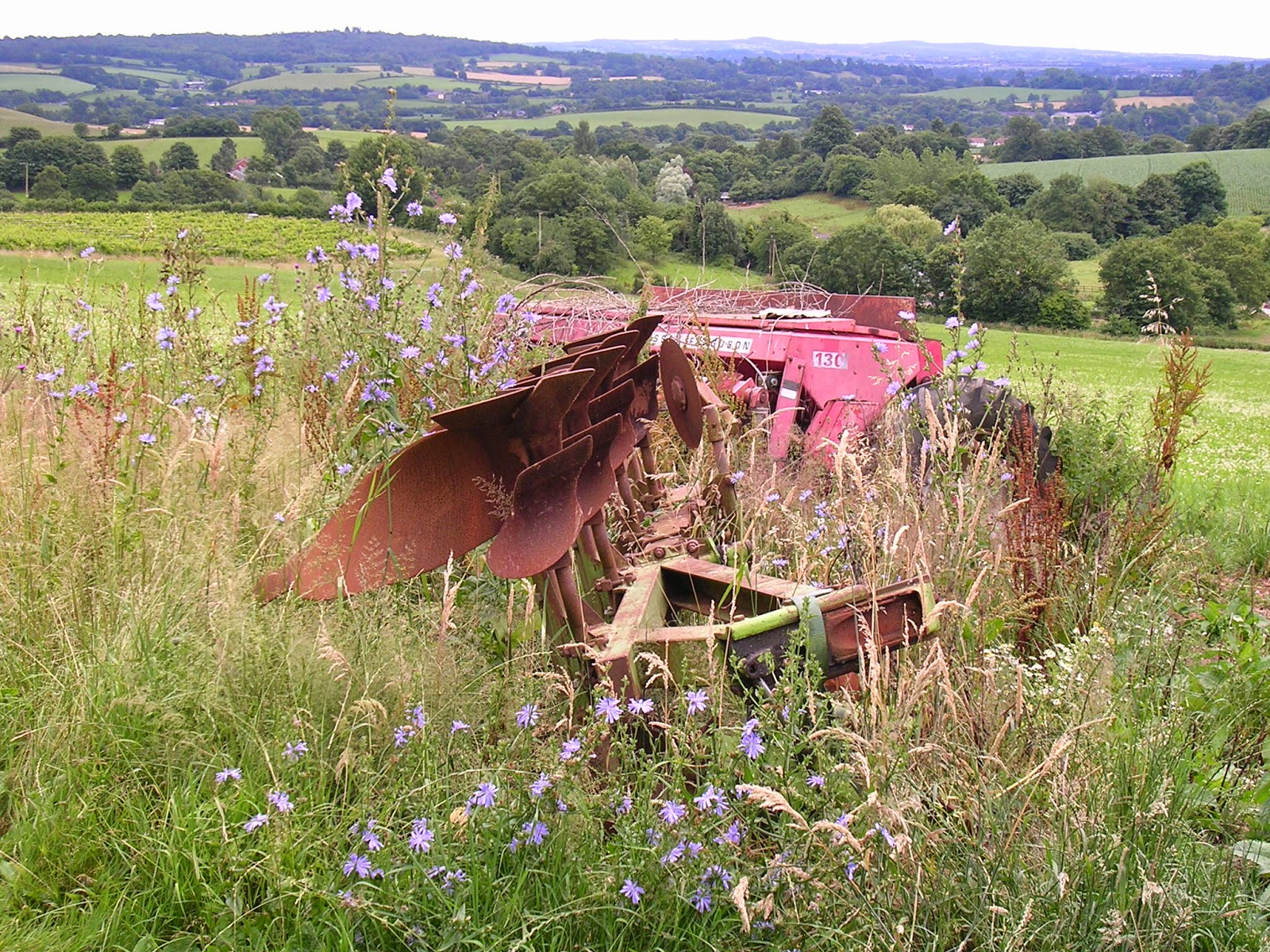
And talking of wildness . . .
. . . what could be more lovely than this patch?
Chicory and old farm machinery photographed this morning at the top of the field behind the house:
Chicory and old farm machinery photographed this morning at the top of the field behind the house:
 |
 |
Wednesday, 2 July 2014
Wild Greece
There are many things I love about Greece – the stunning scenery, the food, the friendly people, the simple lifestyle, the heat – but as we drove home from the airport on Monday after a two-week holiday on a Greek island I realised that what I love about the country above all is its wildness.
It’s the result I suppose of the terrain – mountainous, rocky and islandy – which makes it hard to travel around and hard to cultivate. It’s maybe also because of the people – they’re a bit wild too; they don’t seem to have our mania for neatness and safety. They don't have to 'improve' things all the time.
Or perhaps the people are the result of the terrain.
Whatevs (as my sister would say), here are some pictures from the holiday.
 | ||
| One of the island's many ruined windmills and ruined houses, just left gracefully crumbling. (Spot the Frog.) |
 |
| A happy goat, with crumbling terrace walls and gnarled olive tree. (I have this picture as my desktop at the moment - it makes me smile every time I see it.) |
 |
| Chickens, wandering free through the wood |
 | |
| There were swallows nesting above the doors and windows of all the shops and tavernas. Here are some at the bakery. At the supermarket they flew around inside and perched on the freezers. |
 |
| Entish olive |
They'd had a late spring, with lots of rain, so there were still wildflowers in abundance (and butterflies of all shapes, sizes and colours).
 |
| Fragrant clematis straggling over a wall on the way to the beach |
 |
| Lavender (I think), growing out of rock |
 |
| An orchid (I think) which suddenly appeared one day beside the road we took to the beach. I saw some others too, different ones, but the wind was blowing so hard that day I couldn't get a proper picture. |
 |
| Centaury, which carpeted dry ground turning it vivid pink |
 |
| A plant I'd never seen before but identified as going by the wonderful name of Spiny bear's breech, with wild carrot |
 |
| A close-up of the striking flowers of Spiny bear's breech |
 |
| The leaves of Spiny bear's breech. The plant belongs to the Acanthus family and, according to my Mediterranean wildflower book, the leaves of Acanthus species 'are believed to have inspired the decorative foliage on the capitals of Corinthian pillars in classical Greece'. Not being an architectural expert, I can't vouch for that. |
Thursday, 5 June 2014
Common Blue?
The best way to learn about wild flora and fauna is to have someone point things out to you.
That is the way I learnt about wildflowers. The mother of one of my friends in the village where I was brought up was extremely knowledgeable and took me and my friend for long walks and helped us identify everything we saw. We were doing a wildflower diary as a biology project at the time. My friend got first prize for the project and I got second. I was furious at the time, but it was of course only right.
Unfortunately I’ve never had anyone to help me with birds or butterflies, and I struggle because what I see never looks like the pictures in the books and because the darned creatures move too much.
Here is a little blue butterfly which I see quite a lot of. This morning I managed to capture it on camera and, after a lot of perusal of my books, I have decided that it is the Common Blue.
If you know better, I’d love to hear from you

Tuesday, 27 May 2014
Seakale
 |
| The rare Seakale on an East Devon beach last August |
Watching BBC2's Springwatch last night (which was on Minsmere RSPB Reserve on the Suffolk coast), I discovered the name of the plant I saw on an East Devon beach last August but couldn’t identify. It’s Seakale.
The plant grows on shingle beaches in the south (mostly) and used to be abundant. You can eat the leaves however and in the eighteenth century became fashionable and was harvested almost to extinction. I feel quite privileged therefore to have seen it.
My two older wildflower books say it flowers June to August, but my newest one (published 2008) says it flowers May to September – a sign of changing climate, I suppose. Another interesting point. (Well, I find it interesting anyway.)
Friday, 9 May 2014
Buttercups
I know buttercups are anathema to farmers because they can poison grazing animals, but they don't half look nice.


Friday, 2 May 2014
Bad and good news
I’m not a fan of The News (on television and radio). Much of it is prurient. Most of it is bad. You get the beginning of a story but not the end. It adds nothing to the sum of human happiness. It was only by chance therefore that I came across the following happy ending.
Last year, as you may remember, seabirds were dying in their thousands on West Country beaches. The cause turned out to be a chemical called PIB (polyisobutylene) discharged by boats. (What they were doing with it and why they got rid of it, I don’t know.)
The Devon Wildlife Trust, RSPB and RSPCA among others launched themselves at the problem and over 25,000 people signed petitions (me among them and maybe you too), and in October last year the International Maritime Organisation changed the chemical’s classification so that it can no longer be discharged at sea.
As the latest DWT magazine says, ‘Change in pollution legislation often comes very slowly, while international change only moves at the speed of a glacier. However, this time things were different . . . Campaigning for wildlife really does bring results.’
 |
 |
| The DWT article, with some delightful pictures of guillemots, one of the birds worst hit by the PIB pollution |
Subscribe to:
Posts (Atom)